

I am standing in the household cleaning isle of my local supermarket, confused, irritated, and full of self-doubt. There is just one task to complete: to buy laundry detergent. A simple task, I hear you say. On the contrary my dear reader, for what should have been a basic errand has become an intense exercise in decision-making, complete with doubts, second-guessing, and a strong sense of paralysis by analysis. There are detergents promising “deep-cleaning enzymes”, “hypoallergenic formulas”, “eco-friendly”, “with lavender freshness”, “no dyes or perfumes”, etcetera ad infinitum. Should I phone a friend? Go 50:50? Ask the audience (staff)? I need help!
Decision-making is something that we choose to do, and are required to do, all day and every day (c. 35,000 times apparently!). Sometimes we do it alone, other times we do it with others. Occasionally we decide mindfully, often it’s an automated process. Face too many decisions and it can literally exhaust us (Steve Jobs was onto something with his one-outfit wardrobe for every day dressing). And making an important decision can be hard, really hard, particularly if you’re needing to choose a course of action which affect others.
As a manager or leader, high quality decision-making is one of the most important skills you can possess. Arguably, it may well be the most important. Different situations, environments, and people each require a specific method for making a good decision.
But how do you decide on the decisive approach? Should you adopt a directive style? Think of Elon Musk commanding teams with a clear vision and specific orders, aiming to push rapid innovation to meet ambitious goals. Or how about a more participative style, such as Phil Jackson (former coach of the Chicago Bears and LA Lakers) who would involve players such as Michael Jordan and Kobe Bryant in the decision-making process, especially for high-stakes games, thereby fostering a strong team culture. Or perhaps something a little more analytical? Amazon is highly analytical in its’ decision-making, using data-driven insights for everything from logistics to customer experience. CEO Jeff Bezos is renowned for his “Disagree & Commit” philosophy, which means that even when there is a disagreement, a decision can be made as a result of data analysis, followed then by a commitment to execute it.
The most important consideration for decision-making is to use an approach which is appropriate for the context in which you find yourself. Skilled operators are always adaptable and willing to flex to the situation, whereas those less-skilled tend to use the “This is how I do things” way. For the sake of those you lead and manage, go with the skilled approach if you want to get the best result for the team and it’s members!
To help you effectively navigate through your next decision-making situation, take a look at these short summaries of eight different approaches:
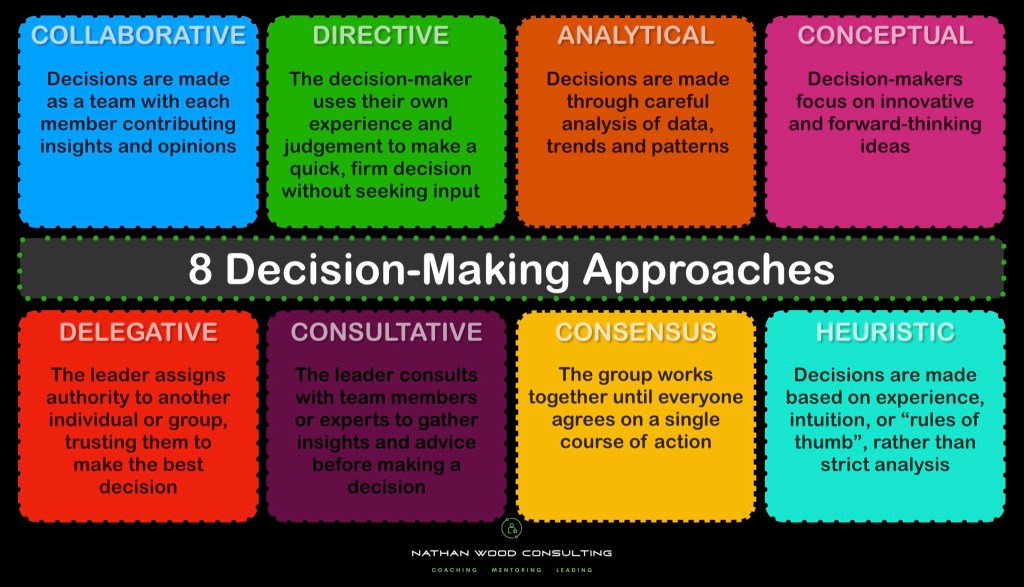
Collaborative
The emphasis here is on teamwork and open discussion, allowing for a shared sense of responsibility and buy-in. For example: Think of Toyota and its’ “Kaizen” philosophy, which encourages continuous improvement. Toyota often involves workers at all levels in problem-solving processes, making decisions collaboratively to improve manufacturing and operational efficiency.
Directive
This approach focuses on efficiency and decisiveness. For example: Sir Alex Ferguson, the former manager of Manchester United, exemplified a directive style. He set clear expectations and often made swift, uncompromising decisions about tactics, discipline, and selection, establishing his authority and creating a culture of accountability.
Analytical
This relies on objective evidence and a thorough evaluation of options. For example: Under CEO Ron Johnson’s leadership, J.C.Penney failed due to an over-reliance on data and analytical decisions, without testing changes in a real-world setting. Johnson eliminated coupons and discounts based on analytical predictions, but the failure to understand the brand’s traditional customer base led to a huge drop in sales.
Conceptual
This is all about brainstorming new approaches and being open to exploring multiple possibilities and long-term solutions. For example: Apple, under Steve Jobs, relied on a conceptual approach, envisioning products which hadn’t been imagined before, such as the iPhone or iPad. Jobs focused on innovative ideas, taking calculated risks to bring visionary products to the market.
Delegative
This style empowers others and fosters independence. For example: Warren Buffett, the chair and CEO of Berkshire Hathaway, is known for a delegative approach. Buffett typically acquires companies and then encourages their existing management teams to operate independently, trusting them to make the best decisions for their business units.
Consultative
Despite wide consultation, the leader retains full control over the final choice. For example: Google often uses a consultative approach. Leaders solicit input from a diverse array of teams, creating a culture where ideas are gathered from many sources before the leader makes a final decision.
Consensus
Consensus decisions require compromise and often take longer to reach, as everyone must be on the same page. For example: Kodak faced some major decisions when digital photography emerged, but through trying to gain a broad consensus amongst stakeholders (who were invested in film-based revenue), the company delayed decisive action to pivot to digital. This led to a significant loss in market share as competitors embraced the new technology faster.
Heuristic
Heuristic decision-making is faster and may rely on practical shortcuts. For example: In fast moving sports, players such as Roger Federer use heuristic decision-making during a match, relying on experience and intuition rather than exhaustive analysis to make quick, strategic choices under pressure.
For those of you still reading, thank you! And you will have noticed, in the examples above, that some were positive accounts, and some less so. In reality though, all the decision-making approaches can either work or not work. They all have their pros and cons. To illustrate this, I could have easily swapped Jose Mourinho for Alex Ferguson for the directive example. Jose’s management style at Manchester United became problematic when his directive approach led to a clash with players. His top-down, often confrontational, decision-making created tension and affected team morale, ultimately leading to his dismissal as players became demotivated under his leadership. Let me take this opportunity to adapt a well-known phrase: “It’s not what you do, it’s the way that you do it”.
And of course, other considerations need to be reckoned with too. Successful decision-making often requires the ability to shift between styles based on context, relevant stakeholders, and the level of risk involved.
Depending on the situation, each style can be advantageous. Factors such as team dynamics, urgency, and the complexity of the decision all play an important role in determining the most effective approach. Put another way, when you know which brush to use, it’s your artistry which will make it a masterpiece…….or not.
Now, shall I go for the Fairy Non-Bio, or the Persil Ultimate? I had better phone a friend!
Please do get in touch if you have any comments or questions on this article, or if you’d like to suggest a topic for another piece.



 Nathan Wood Consulting